
Guide one
Capsule Wardrobe
A capsule wardrobe is a small set of clothes that all work together. You get dressed faster, spend less, and still have plenty of outfits.
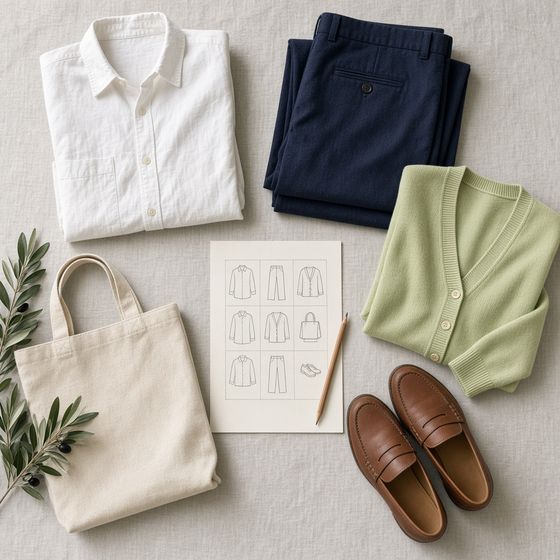
Start with your real week
Before buying anything, write down how you spend a typical week: office days, home days, school runs, workouts, evenings out. A wardrobe built for an imagined life stays in the cupboard. Count roughly how many days fall into each category and let those proportions guide your choices.
Take stock
- Empty one section at a time, for example tops, then trousers.
- Sort into three piles: love and wear, maybe, and no longer fits your life.
- Box the maybes for a season. If you do not miss them, let them go by selling, donating or recycling.
- Note the gaps. Perhaps you have six patterned tops and no plain trousers to wear them with.
Choose a colour story
Pick one or two base neutrals (navy, charcoal, black, stone, camel or white), then one or two accent colours you love wearing. If every base piece goes with every other, accents become easy. The 60-30-10 idea helps: most of the wardrobe in the base, some in a second neutral, a little in the accent.
A starting list
| Category | Typical number | Notes |
|---|---|---|
| Tops | 8–12 | Mix plain tees, shirts and knits in your base and accent colours |
| Bottoms | 4–6 | Different weights and shapes in base colours |
| Dresses or jumpsuits | 1–3 | Pieces that work dressed up or down |
| Layers | 3–4 | A cardigan, a blazer or overshirt, a light jacket |
| Outerwear | 1–2 | Chosen for your climate |
| Shoes | 3–5 | Comfortable everyday pair, smarter pair, weather pair |
These numbers are a starting point, not a rule. Many people end up with 25 to 40 pieces per season, not counting underwear, sleepwear and sportswear.
Fit and fabric first
A simple piece that fits well looks better than an expensive one that does not. Check shoulders, sleeve length and trouser hems. Small alterations from a tailor are often cheap and make a big difference. Natural or durable fabrics, such as cotton, linen, wool and good blends, usually last longer and look better with age.
Shop slowly
- Keep a short list of real gaps on your phone and buy only from it.
- Before buying, name three things you already own that it goes with.
- Work out the cost per wear: price divided by how often you will realistically wear it.
- Look at second-hand shops and resale sites for good basics.
Seasons change. Store off-season clothes clean and dry, then swap them in. A seasonal swap is a natural moment to edit again.
Try this. For one week, choose outfits only from ten pieces plus shoes. Note which combinations you liked and which piece you missed most.